AI Business Context Refinement: A Practical Guide
AI business context refinement is the foundation for turning generic AI into reliable, business-ready systems that understand your workflows, policies, customers, and goals. Teams often plug AI into support, sales, or operations and expect instant magic—then get vague answers, policy-breaking suggestions, or confident mistakes. The missing piece isn’t a bigger model; it’s context. When you systematically refine and inject business context, AI becomes accurate, compliant, and measurably useful across real workflows.
In 2025–2026, organizations adopting contextual AI, retrieval-augmented generation (RAG), and domain adaptation are seeing faster resolution times, lower error rates, and stronger ROI. This practical guide shows you how to design, implement, govern, and scale context refinement—from beginner-friendly steps to advanced enterprise strategies—so AI moves from experiments to dependable production systems.
What AI Business Context Refinement Really Means (and Why It Matters)
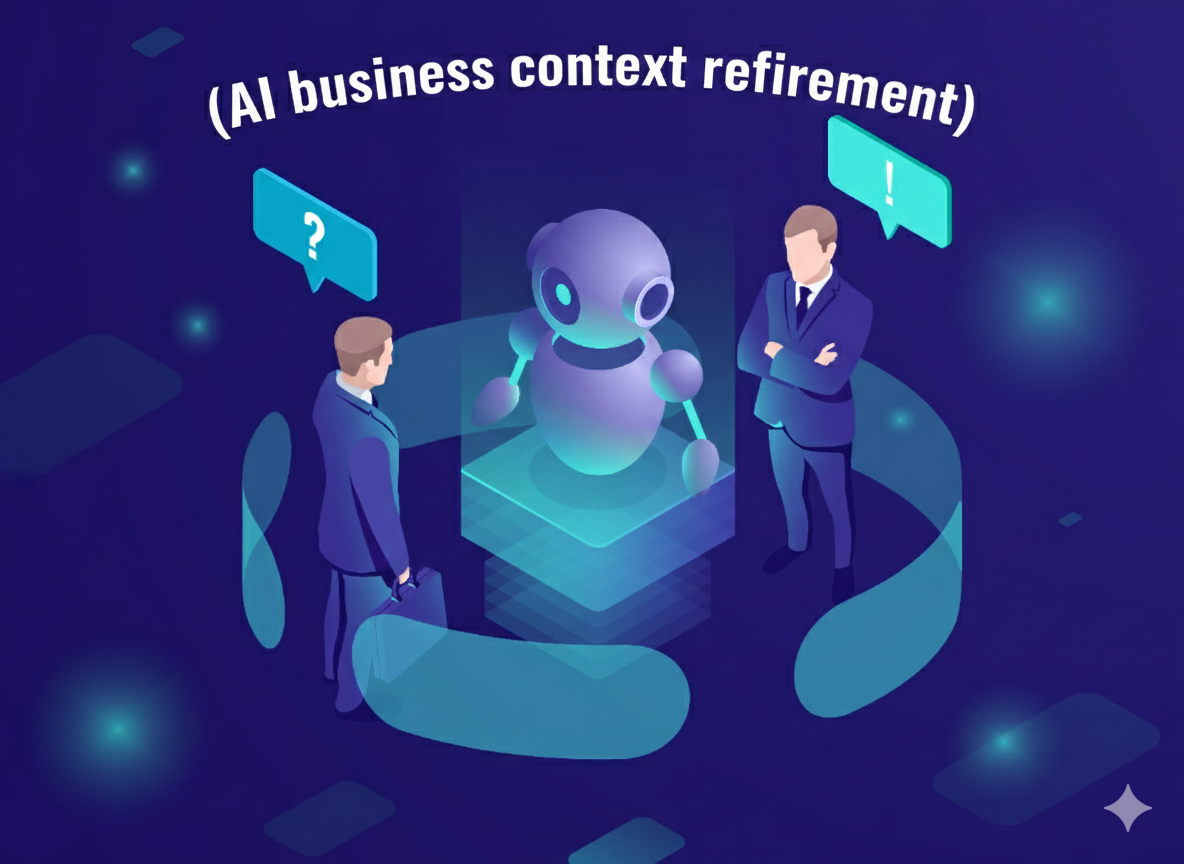
AI business context refinement means systematically feeding your organization’s knowledge, rules, and workflows into AI systems so outputs reflect how your business actually operates. It’s not just prompt engineering; it’s building repeatable context pipelines that shape behavior over time.
Three layers of business context
-
Data context
Product catalogs, FAQs, knowledge bases, SOPs, pricing tables, CRM/ERP records -
Rule context
Brand voice, discount limits, compliance rules, escalation policies -
Workflow context
Task flows, handoffs, approvals, edge cases
Why it matters
-
Relevance: Answers match your products and customers
-
Consistency: Tone and policy adherence across teams
-
Compliance: Lower legal and regulatory risk
-
Productivity: Less rework; faster decisions
Prompting vs. Context Pipelines
| Dimension | Prompt Engineering | Context Refinement Pipelines |
|---|---|---|
| Scope | One-off responses | Persistent behavior |
| Consistency | Low | High |
| Scale | Manual | Automated |
| Governance | Weak | Strong (logs, access control) |
| Best use case | Experiments | Production workflows |
Takeaway: Prompts help you explore. Context pipelines help you scale.
Why Generic AI Fails in Real Business Scenarios
General-purpose AI models are trained on broad public data. They don’t know your policies, pricing rules, or operational realities. The result: confident but wrong answers (hallucinations), policy violations, and mismatched tone.
Common failure modes
-
Suggesting discounts outside approved limits
-
Ignoring compliance constraints
-
Recommending workflows your team doesn’t use
-
Drifting brand voice across channels
Root causes
-
No access to internal knowledge
-
No rule enforcement layer
-
Model drift as policies change
-
Stale documents powering retrieval
What fixes it
-
RAG to pull fresh, relevant facts at runtime
-
Human-in-the-loop reviews for high-risk steps
-
Continuous feedback loops to improve sources
-
Rule checks before responses are delivered
Result: Higher operational accuracy, fewer incidents, and growing trust in AI outputs.
Who Needs Context Refinement: SMBs vs. Enterprises
Both SMBs and enterprises benefit from context refinement; they just start at different scales.
SMBs (fast ROI, lean stacks)
-
Start with FAQs + policies
-
Pilot one workflow (e.g., support replies)
-
Lightweight RAG; measure time saved
-
Expand after quick wins
Enterprises (scale + governance)
-
Multi-department context layers
-
Audit logs, role-based access
-
ERP/CRM integrations
-
Central governance with team-specific overlays
High-impact use cases
-
Customer Support: Refund rules, escalation paths
-
Sales: Pricing limits, ICPs, objection handling
-
Marketing: Brand voice, compliance claims
-
Operations/Compliance: SOPs, regulatory checks
Pro tip: Start small, prove ROI, then scale across departments.
How AI Business Context Refinement Works (From Data to Decisions)
Business Context Injection: Data, Rules, and Workflows
Context injection ensures AI receives the right knowledge at the right moment.
A practical pipeline
-
Curate trusted sources (SOPs, KBs, policies)
-
Structure content with tags and metadata
-
Retrieve relevant snippets via RAG
-
Apply rule checks (pricing, compliance)
-
Log outputs for audits and learning
Quality checklist
-
Version policies
-
Retire stale docs
-
Restrict sensitive fields
-
Validate with reviewers
Outcome: Fewer hallucinations, more compliant outputs, faster cycles.
Prompt Engineering vs. Contextual Pipelines (When to Use Each)
Hybrid approach that works
-
Use prompts to prototype
-
Convert stable patterns into pipelines
-
Add monitoring + feedback loops
Why hybrid wins: You move fast without sacrificing reliability.
RAG and Knowledge Graphs for Contextual AI
-
RAG: Retrieves up-to-date facts at runtime
-
Knowledge graphs: Connect entities (products → policies → procedures)
Best for
-
Policy-heavy workflows
-
Multi-source answers
-
Rapidly changing knowledge
Watch-out: Stale sources = stale answers. Automate updates.
Tools and Platforms for Contextual AI in Business
Many teams build on platforms from OpenAI, Anthropic, and Google. These support system instructions, tool calling, and retrieval—core to business context refinement. For teams exploring AI tools, platforms like Gramhir Pro AI can help implement business context refinement and automate workflows efficiently.
How to choose a platform
-
Context window size
-
Tool/function calling
-
Governance & logging
-
Cost predictability
-
Ecosystem integrations
Typical integration stack
-
CRM/ERP + knowledge bases
-
Secure APIs
-
Identity and access management
RAG vs. Fine-Tuning: What to Use and When
| Approach | Best For | Pros | Cons |
|---|---|---|---|
| RAG | Changing knowledge | Fresh info, lower risk | Needs clean sources |
| Fine-tuning | Stable style/behavior | Consistent tone | Higher cost, slower updates |
Rule of thumb: Start with RAG for knowledge. Add fine-tuning only when behavior must be deeply customized.
Implementing AI Business Context Refinement (Step-by-Step)
1) Map Business Processes and Context Sources
Identify workflows where AI can save time or reduce risk:
-
Support → FAQs, refund rules
-
Sales → pricing limits, ICPs
-
Ops → SOPs, checklists
Deliverable: A context map linking tasks → sources → rules.
2) Design Context Pipelines and Feedback Loops
-
Add human-in-the-loop for high-risk outputs
-
Capture errors and corrections
-
Review monthly
Simple loop
Retrieve → Respond → Review → Improve sources → Repeat
3) Test and Validate in Real Workflows
KPIs to track
-
Accuracy rate
-
Time saved per task
-
Rework reduction
-
Compliance incidents
Tip: Pilot with one team before org-wide rollout.
Measuring ROI and Business Impact
Operational KPIs
-
Resolution time
-
Cost per ticket
-
Error rate
-
CSAT / conversion rate
Revenue and efficiency links
-
Faster support → lower churn
-
Better sales answers → higher close rates
-
Automated ops → lower overhead
ROI model
-
SMBs: Pilot → measure → expand
-
Enterprises: Phased rollout with dashboards + audits
To get a complete picture of AI impact, it’s also helpful to track metrics like how to track brand mentions in AI search to see how often your brand appears across AI-generated results.
Governance, Security, and Responsible AI
Governance essentials
-
Approval workflows
-
Audit logs
-
Role-based access
Security best practices
-
Encrypt data in transit/at rest
-
Mask sensitive fields
-
Least-privilege access
Responsible design
-
Bias reviews
-
Hallucination monitoring
-
Regular policy updates
Outcome: Safer, compliant AI at scale.
Advanced Strategies for Scaling Context Refinement
Model drift management
-
Quarterly source reviews
-
Retire outdated policies
-
Monitor error trends
Multi-team context layers
-
Shared core knowledge
-
Team-specific overlays
Automation with APIs
-
Auto-sync docs
-
Alerts for stale content
-
Real-time monitoring
Real-World Use Cases of Contextual AI
Customer Support
-
Policy-aware assistants improve first-contact resolution and reduce escalations.
Sales & Marketing
-
ICP-aware AI personalizes outreach while respecting pricing and claims.
Operations & Compliance
-
SOP-guided automation reduces manual errors and audit findings.
Common Mistakes and How to Avoid Them
-
Over-relying on prompts: Build pipelines for scale
-
Ignoring governance early: Add controls from day one
-
No ROI tracking: Measure, iterate, and expand intentionally
Conclusion
AI business context refinement turns generic AI into dependable, production-ready systems. When AI understands your data, rules, and workflows, accuracy improves, risk drops, and teams move faster across support, sales, marketing, and operations. Start with one high-impact workflow, layer in contextual AI with RAG, add governance and feedback loops, and scale deliberately. Context—not just model size—is what transforms AI into a trusted business partner.