AI Tool for Flooring Measuring Lead Scoring: 2026 Guide
An AI tool for flooring measuring lead scoring helps flooring companies automatically measure floor space, estimate project value, and prioritize the most profitable sales leads. Instead of manually measuring every property and chasing every inquiry, businesses can use AI to focus on the customers most likely to convert.
As competition grows in the home renovation market, flooring contractors are discovering that combining AI measurement technology with predictive lead scoring dramatically improves sales efficiency. With faster quotes, better lead prioritization, and automated workflows, companies can close more deals while reducing wasted time on low-value prospects.
Why Flooring Businesses Are Turning to AI
The flooring industry has traditionally relied on manual processes. Contractors often send estimators to measure rooms, calculate materials, and prepare quotes. While this method works, it is slow, expensive, and difficult to scale.
AI technology changes this process completely. Instead of waiting for on-site visits, homeowners can upload photos or floor plans and receive measurements instantly. Sales teams can then use AI lead scoring to identify which projects are worth prioritizing.
Several factors are driving this shift:
-
Customers expect fast quotes and digital experiences
-
Sales teams receive large numbers of low-quality leads
-
Travel and labor costs for measurements continue to rise
-
CRM platforms now support AI-driven automation
The result is a more efficient sales pipeline where businesses focus their time on the projects that matter most.
What Is an AI Tool for Flooring Measuring Lead Scoring?
An AI flooring measurement and lead scoring tool is a software system that combines two powerful technologies: automated floor measurement and predictive lead scoring.
The measurement component uses computer vision or LiDAR scanning to analyze images or floor plans. It calculates square footage, room dimensions, and material requirements in seconds. This data becomes the foundation for project estimation.
The second component analyzes that information using machine learning models. The system evaluates factors such as project size, flooring type, budget signals, and customer engagement to determine how likely a lead is to convert.
Together, these technologies create a smart workflow where:
-
floors are measured automatically
-
project value is estimated instantly
-
leads are ranked by conversion potential
Instead of treating every inquiry equally, companies can prioritize the most valuable opportunities.
The Core Problems Flooring Companies Face Today
Many flooring contractors struggle with inefficiencies in their sales process. These challenges often prevent businesses from scaling even when demand is high.
One major issue is the large number of unqualified leads. Homeowners frequently request quotes simply to compare prices or gather rough estimates. Sales teams may spend hours responding to prospects who never intend to purchase.
Another challenge is the cost of manual measurement. Sending a technician to every property requires travel time, labor costs, and scheduling coordination. When the customer decides not to proceed, that investment is lost.
Slow quoting processes also create problems. If a competitor provides a faster estimate, the customer may move forward with them instead. In today’s market, speed often determines who wins the project.
Finally, many companies struggle with disconnected systems. Leads arrive through websites, email forms, and advertising platforms, but the data rarely integrates smoothly with CRM systems or measurement tools.
An AI solution addresses these issues by automating measurement, estimating project value quickly, and helping teams focus on the most promising opportunities.
How AI Floor Measurement Technology Works
AI measurement tools analyze images or digital floor plans using advanced computer vision algorithms. These systems detect room boundaries, identify corners and walls, and calculate floor area with impressive accuracy.
In many modern apps, homeowners simply take photos of their rooms using a smartphone. The software processes the images and converts them into measurable floor plans. Other platforms allow customers to upload existing architectural drawings or renovation plans.
Some tools also use LiDAR sensors, which are available on many modern smartphones and tablets. LiDAR scanning captures depth information, allowing the system to produce highly accurate room measurements in seconds.
Once measurements are calculated, the software generates key data points:
-
total square footage
-
room dimensions
-
material coverage requirements
-
estimated installation scope
This information feeds directly into project estimation systems and AI lead scoring models.
How AI Lead Scoring Works for Flooring Companies
AI lead scoring uses machine learning to analyze customer data and predict which prospects are most likely to become paying customers.
Instead of relying on simple rules, such as assigning points for form submissions or email clicks, AI models evaluate dozens of signals simultaneously. These signals often include both behavioral data and project characteristics.
For flooring businesses, the most important signals typically include:
-
project size based on square footage
-
type of flooring requested such as hardwood or luxury vinyl
-
property value or location
-
estimated project budget
-
customer engagement level
The AI model compares these signals with historical sales data. Over time, it learns which patterns are associated with successful deals.
Each lead then receives a score indicating its likelihood of conversion. Sales teams can use this score to prioritize their outreach and focus on high-value projects first.
Complete Workflow: From Flooring Inquiry to Sales Conversion
One of the most powerful aspects of AI sales systems is how they connect measurement, estimation, and lead scoring into a single workflow.
The process usually starts when a customer submits a request on a company’s website. They may upload room photos, provide a floor plan, or describe the renovation project they are planning.
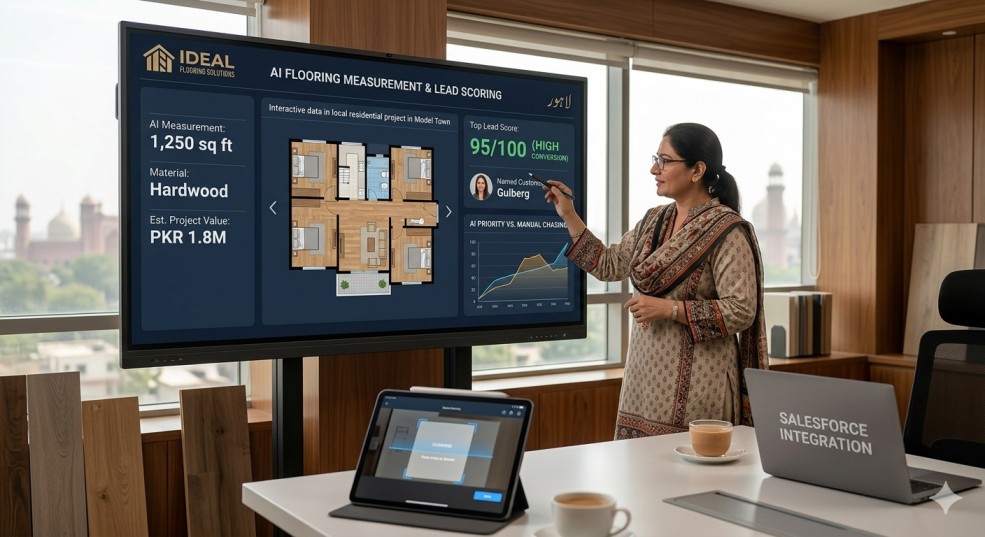
The AI measurement engine analyzes the images and calculates square footage. This data feeds into an estimation engine that predicts the approximate project value based on material costs and installation requirements.
Next, the lead scoring system evaluates the project using machine learning models. It considers the measurement data, location, budget indicators, and engagement signals.
Finally, the CRM system receives the lead score and assigns the opportunity to a sales representative. High-value leads can trigger immediate notifications, while lower-priority leads may enter automated follow-up campaigns.
This workflow allows flooring companies to respond quickly while focusing their attention on the most promising projects.
Key Features to Look for in an AI Tool
When choosing an AI system for flooring measurement and lead scoring, businesses should evaluate several important capabilities.
First, measurement accuracy is critical. A reliable tool should produce measurements within a small margin of error compared to manual methods. This ensures estimates remain trustworthy.
Second, the platform should include predictive lead scoring models capable of analyzing project characteristics and customer behavior. These models should improve over time as more data becomes available.
Another important feature is CRM integration. The system should connect with popular platforms so that sales teams can see lead scores directly within their existing pipeline.
Automation capabilities are also valuable. Many tools allow companies to trigger actions such as sending quotes, scheduling appointments, or assigning leads automatically.
Finally, developers often prefer tools that provide API access. This allows businesses to integrate measurement and scoring capabilities into custom applications or websites.
Best AI Tools for Flooring Measurement and Lead Scoring
Several tools can help flooring companies build an AI-powered sales system.
For measurement technology, popular platforms include mobile scanning apps and digital floor-plan analysis tools. These solutions convert images or scans into precise measurements quickly.
For lead scoring, CRM platforms with AI capabilities can analyze customer behavior and project characteristics to predict which leads are most valuable.
Automation platforms also play a role by connecting measurement tools, CRM systems, and marketing platforms into a single workflow.
By combining these tools, flooring companies can create a powerful system that automates measurement, prioritizes leads, and accelerates sales cycles. If you’re exploring more AI-powered solutions beyond measurement and sales automation, you can also check out these creative AI platforms used by businesses and marketers to discover tools that help with design, marketing, and content production.
Measurement vs Lead Scoring Tools
Different AI solutions specialize in different parts of the process. Some focus on measurement accuracy, while others focus on predictive analytics.
Measurement tools typically provide:
-
image analysis
-
room dimension detection
-
square footage calculations
Lead scoring platforms focus on:
-
predictive analytics
-
CRM integration
-
sales prioritization
The most effective strategy is often to combine both technologies into one integrated workflow.
AI Tool for Flooring Measuring Lead Scoring API
Many AI platforms provide an API that allows developers to integrate measurement and lead scoring capabilities directly into websites or internal systems.
An API acts as a bridge between software applications. When a customer uploads a floor plan, the system sends that data to the AI measurement service through the API. The service processes the data and returns measurement results.
Those results can then trigger the lead scoring engine, which evaluates the opportunity and assigns a score.
APIs make it possible to build fully automated systems where measurements, estimates, and lead scores are generated instantly after a customer submits a request.
AI Tool for Flooring Measuring Lead Scoring API Key
Most APIs require authentication through an API key. This key verifies that requests are coming from an authorized application.
The API key typically appears in request headers and allows the platform to track usage, enforce rate limits, and protect the system from unauthorized access.
Best practices for API keys include:
-
storing them securely in environment variables
-
restricting access permissions
-
rotating keys periodically
-
avoiding exposure in public code repositories
Following these practices ensures that integrations remain secure and reliable.
AI Tool for Flooring Measuring Lead Scoring in Salesforce
Many flooring companies manage their sales pipelines using CRM platforms like Salesforce. Integrating AI measurement and lead scoring with this system creates a powerful sales workflow.
When a lead enters the CRM, the system can automatically retrieve measurement data from the AI tool. The lead scoring engine then evaluates the opportunity and updates the CRM record with a score and estimated project value.
Salesforce workflows can trigger additional actions based on this information. For example, high-scoring leads may be assigned immediately to senior sales representatives or scheduled for on-site consultations.
This integration allows teams to focus on opportunities with the highest revenue potential.
Real-World Use Case
Consider a mid-sized flooring company that receives hundreds of inquiries each month. Before adopting AI tools, the sales team attempted to follow up with every lead equally.
This approach created several problems. Estimators spent significant time visiting properties that never resulted in sales, and high-value renovation projects were sometimes overlooked.
After implementing AI measurement and lead scoring, the company automated its initial qualification process. Customers uploaded room photos, and the system calculated measurements instantly.
Leads were then ranked based on project size, property value, and engagement signals. The sales team focused on the highest-scoring prospects first.
Within a few months, the company reduced unnecessary site visits and increased its conversion rate significantly.
Benefits of AI Lead Scoring for Flooring Businesses
Adopting AI-powered sales tools provides several important advantages.
First, sales teams become more efficient because they spend less time on low-value inquiries. Instead, they focus on prospects with larger projects and stronger buying signals.
Second, automated measurement allows businesses to generate quotes faster. Customers appreciate quick responses and are more likely to move forward with companies that provide immediate estimates.
AI systems also improve forecasting accuracy by analyzing patterns in historical sales data. Managers can better predict demand and allocate resources accordingly.
Finally, customers benefit from a smoother experience. Faster estimates and better communication make the renovation process easier and more transparent.
Challenges and Limitations
While AI tools offer powerful advantages, they also come with some challenges.
Data quality is one of the most important factors. Machine learning models depend on accurate historical data to produce reliable predictions. If data is incomplete or inconsistent, lead scores may be less accurate.
Integration complexity can also create obstacles. Connecting measurement tools, CRM platforms, and automation systems requires careful planning.
Additionally, some companies may face initial implementation costs when adopting new technology. However, many businesses recover these costs quickly through improved efficiency and higher conversion rates.
How to Implement an AI Flooring Measurement and Lead Scoring System
Implementing an AI system typically begins with collecting historical sales data. This information helps train lead scoring models and identify patterns associated with successful projects.
Next, businesses choose an AI measurement platform capable of analyzing room images or floor plans. This tool should integrate easily with existing systems.
The lead scoring model is then configured using past project data and customer behavior signals. Over time, the model becomes more accurate as it processes additional leads.
Finally, the system is integrated with a CRM platform so that sales teams can see scores, measurements, and estimated project values in one place.
Once implemented, the entire process—from inquiry to lead qualification—can operate automatically.
2026 Trends in AI for Flooring Sales
AI technology continues to evolve rapidly, and the flooring industry is beginning to adopt several new innovations.
Augmented reality tools are allowing homeowners to visualize flooring materials directly in their rooms before purchasing. These tools combine measurement data with 3D visualization.
AI-powered renovation estimators are also becoming more advanced. They analyze not only room dimensions but also labor costs, material pricing, and regional market conditions.
Another emerging trend is the use of AI sales assistants that automatically respond to customer inquiries, qualify leads, and schedule consultations.
As these technologies mature, flooring companies will gain even more powerful tools for managing their sales pipelines.
AI adoption is accelerating across industries, and many companies are also using tools that track how AI systems perform and analyze search data. Businesses exploring these technologies can review the latest AI search monitoring tools in this guide to understand how AI insights can improve marketing and sales performance.
Final Thoughts
The combination of automated measurement and predictive lead scoring is transforming the way flooring companies manage their sales pipelines. An AI tool for flooring measuring lead scoring allows businesses to measure spaces quickly, estimate project value instantly, and prioritize the leads most likely to convert.
As AI technology continues to improve, companies that adopt these tools early will gain a significant competitive advantage. Faster quotes, smarter lead prioritization, and automated workflows can help flooring businesses grow while delivering a better experience for customers.
Frequently Asked Questions
How accurate are AI floor measurement tools?
Most modern AI measurement apps are highly accurate when used correctly. Many achieve accuracy levels close to manual measurements, especially when using LiDAR scanning technology.
Can AI estimate flooring project costs?
Yes. Many systems combine measurement data with pricing models to generate approximate project estimates based on square footage and material type.
Do small flooring companies benefit from AI lead scoring?
Even small businesses can benefit from prioritizing their leads. AI helps them focus limited resources on the projects most likely to convert.
Do AI measurement tools work on mobile phones?
Many platforms offer mobile apps that allow homeowners or contractors to scan rooms directly with a smartphone.