
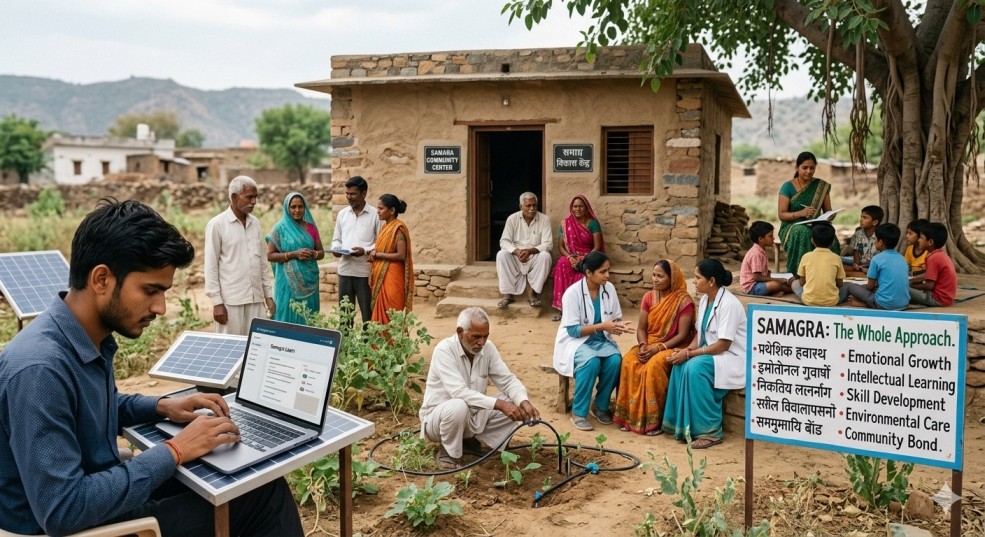
Samagra Meaning in English: Definition, Origin & Examples
Samagra meaning in English is commonly translated as “complete,” “whole,” “comprehensive,” or “holistic.” The word describes something that includes all parts, aspects, or elements together rather than focusing on only one part.
Many people encounter the word Samagra in educational programs, government initiatives, literature, or philosophical discussions. However, its exact meaning and context are not always clearly explained on most websites.
Quick Answer: What Does “Samagra” Mean in English?
The English meaning of Samagra is:
-
Complete
-
Whole
-
Entire
-
Comprehensive
-
Holistic
In simple terms, Samagra refers to something that includes everything and leaves nothing out. It emphasizes a full or integrated approach rather than focusing on a single aspect.
For example:
-
Samagra development means development that focuses on all aspects of growth.
-
Samagra analysis refers to examining a subject from every angle.
Because of this broad meaning, the word is often used when discussing systems, policies, education, and overall development.
Samagra Meaning in English Explained
To fully understand the word, it helps to explore its meaning in more detail.
Literal Meaning of Samagra
The word Samagra literally refers to something that is complete in every part. It describes a state where nothing important is missing.
For instance, if a report provides a Samagra overview, it means the report covers all important aspects of the topic rather than presenting partial information.
Simple Definition in Everyday English
In everyday language, Samagra simply means “all-inclusive” or “complete.”
It suggests a situation where every part of a system, idea, or process is considered together. Instead of analyzing things separately, the focus is on the big picture.
Why the Word Often Means “Holistic”
Many modern contexts translate Samagra as holistic. This is because the word often describes a comprehensive approach that considers physical, emotional, intellectual, or social aspects together.
For example, in education, Samagra development refers to developing students academically, socially, and emotionally rather than focusing only on grades.
Pronunciation of Samagra
Understanding the correct pronunciation helps when discussing the word in conversations or academic contexts.
Phonetic Pronunciation
Samagra is pronounced as:
suh-muh-gruh
How to Say Samagra Correctly
The word can be broken into three simple parts:
-
Sa – sounds like “suh”
-
Ma – sounds like “muh”
-
Gra – sounds like “gruh”
When spoken together, it becomes suh-muh-gruh.
Pronunciation Tips
-
Stress is usually light and evenly distributed.
-
The word flows smoothly without sharp pauses.
Because Samagra originates from classical languages, pronunciation may vary slightly depending on regional accents, but the basic sound remains similar.
Origin and Etymology of Samagra
The word Samagra has deep linguistic roots and originates from Sanskrit, one of the oldest known languages.
Sanskrit Root of the Word
In Sanskrit, the word is written as समग्र (Samagra). It was used in ancient texts to describe completeness, totality, or something that includes every element together.
Meaning of “Sam” and “Agra”
The word is formed from two components:
-
Sam – meaning together, fully, or completely
-
Agra – meaning whole, entire, or foremost
Combined, the word expresses the idea of bringing everything together into one complete whole.
How the Meaning Evolved Over Time
Over time, Samagra became widely used in several Indian languages such as Hindi, Marathi, and Kannada. Its meaning remained largely consistent, always referring to completeness or comprehensiveness.
In modern usage, the word is frequently used in discussions about education, development programs, policy planning, and holistic growth.
Synonyms of Samagra in English
Several English words express a similar idea to Samagra. However, each has slightly different nuances.
Common synonyms include:
| Word | Meaning |
|---|---|
| Complete | Having all parts present |
| Whole | Not divided or missing parts |
| Entire | Total and undivided |
| Comprehensive | Covering many aspects |
| Holistic | Considering the whole system |
| Total | Including everything |
Among these, holistic and comprehensive are often the closest matches because they reflect the broader meaning of Samagra.
Antonyms of Samagra
Understanding the opposite of Samagra helps clarify its meaning even further.
Common antonyms include:
-
Partial
-
Incomplete
-
Fragmented
-
Limited
-
Restricted
For example:
-
A partial analysis focuses on only some parts of a topic.
-
A Samagra analysis considers every important element.
Examples of Samagra in Sentences
To understand the word better, it helps to see it used in real contexts.
Everyday Sentences
-
The report provides a Samagra overview of the company’s performance.
-
The project aims to create a Samagra solution to the environmental issue.
Educational Context
-
Schools focus on Samagra development so students grow intellectually and emotionally.
-
Teachers encourage a Samagra learning approach rather than memorizing information.
Professional or Formal Examples
-
Policymakers adopted a Samagra strategy to improve public healthcare.
-
Researchers conducted a Samagra study of climate change impacts.
These examples show that the word is commonly used when discussing systems, strategies, or development processes. Just like people search for the Samagra meaning in English, many also try to understand modern texting abbreviations such as ML, which you can learn about here:
ML meaning in text messaging
Common Phrases Using the Word Samagra
Several phrases use the word Samagra in meaningful ways.
Samagra Vikas (Holistic Development)
This phrase refers to development that includes all aspects of human growth, such as physical, emotional, intellectual, and social development.
It is commonly used in educational and social development discussions.
Samagra Shiksha
This phrase refers to an integrated education approach aimed at improving the quality of schooling from early childhood to higher secondary education.
The idea is to create a comprehensive education system rather than isolated improvements.
Samagra Approach
A Samagra approach means addressing a problem by considering all factors and perspectives together.
This approach is common in fields like policy planning, research, and organizational management.
Samagra Meaning in Different Languages
Although the word comes from Sanskrit, it is widely used across multiple languages.
| Language | Word | Meaning |
|---|---|---|
| Sanskrit | Samagra | Entire or complete |
| Hindi | Samagra | Whole or comprehensive |
| Marathi | Samagra | Total or inclusive |
| Kannada | Samagra | Complete |
Across languages, the central idea remains the same: something that includes every important part.
Samagra vs Sampoorna: What’s the Difference?
People sometimes confuse Samagra with Sampoorna, but the two words have subtle differences.
| Word | Meaning | Usage |
|---|---|---|
| Samagra | Holistic or comprehensive | Used when discussing systems or approaches |
| Sampoorna | Fully finished or complete | Used when something is totally done |
For example:
-
Samagra development refers to development covering many aspects.
-
Sampoorna work means work that has been completely finished.
Understanding this difference helps avoid confusion when using these terms.
Where the Word Samagra Is Used in Real Life
The concept of Samagra appears in many areas of modern life. Language keeps evolving over time. While people search for classical word definitions like Samagra meaning in English, they also look for modern slang such as WYLL meaning in texting, which is explained in this guide:
Education
Educational systems often emphasize Samagra development, focusing on building knowledge, creativity, character, and social skills.
Government Policies
Many policies are designed using a Samagra framework, which means solving problems through integrated solutions rather than isolated programs.
Personal Development
Self-improvement discussions sometimes promote Samagra growth, encouraging people to improve mental, emotional, and physical wellbeing together.
Academic and Cultural Contexts
In academic writing and cultural discussions, Samagra may describe a complete interpretation of a text, philosophy, or social system.
Why the Concept of Samagra Is Important
The idea behind Samagra is important because it promotes balanced thinking and comprehensive understanding.
Many problems occur when people focus only on one aspect of a situation. A Samagra perspective encourages decision-makers to consider all relevant factors before taking action.
For example, improving education requires more than new textbooks. It may involve teacher training, student wellbeing, infrastructure, and community involvement. A Samagra strategy addresses all these elements together.
This holistic mindset is why the concept continues to be relevant in modern policy discussions and development initiatives.
Common Mistakes When Understanding the Word Samagra
Although the definition seems simple, people often misunderstand the word.
Confusing Samagra with “Complete”
While Samagra does mean complete, it usually implies completeness across multiple aspects, not just a finished state.
Assuming It Only Applies to Development
Although frequently used in development discussions, the word can describe any comprehensive system or approach.
Ignoring the Holistic Meaning
Some translations focus only on the word “complete,” but the deeper meaning often involves integrated thinking and holistic understanding.
Recognizing these distinctions helps use the word more accurately.
Quick Summary of Samagra Meaning
Here is a quick recap of the key points:
-
Samagra means complete, whole, or holistic.
-
The word originates from Sanskrit.
-
It describes something that includes all parts or aspects together.
-
It is widely used in discussions about education, development, and policy planning.
-
The concept emphasizes comprehensive thinking and integrated solutions.
Conclusion
Understanding the Samagra meaning in English goes beyond a simple translation. While the word can be translated as complete or whole, its deeper meaning reflects a holistic perspective that values integration and balance.
In modern contexts, Samagra often describes approaches that consider multiple dimensions of a problem instead of addressing issues in isolation. This is why the concept appears frequently in education systems, government initiatives, and discussions about sustainable development.
By adopting a Samagra mindset, individuals and organizations can better understand complex challenges and design solutions that address root causes rather than symptoms.
If you encounter the word in policy documents, educational discussions, or philosophical texts, remember that it represents a comprehensive view that connects all parts into a meaningful whole. This broader perspective is what gives the term its lasting relevance.
FAQs
What is the meaning of Samagra in English?
Samagra means complete, whole, comprehensive, or holistic. It refers to something that includes all parts or aspects together.
Is Samagra a Sanskrit word?
Yes, Samagra originates from Sanskrit, where it describes completeness or totality.
What is Samagra development?
Samagra development refers to holistic growth that considers multiple aspects such as physical, emotional, and intellectual development together.
What does Samagra Shiksha mean?
Samagra Shiksha refers to an integrated approach to improving education systems by addressing various components such as teaching quality, infrastructure, and student learning outcomes.
Is Samagra the same as complete?
Not exactly. While it can mean complete, Samagra often emphasizes a holistic or comprehensive approach rather than simply something finished.